Books 2012: A new year, a new tag
Jan. 12th, 2012 06:36 pm![[personal profile]](https://www.dreamwidth.org/img/silk/identity/user.png) hawkwing_lb
hawkwing_lbBooks 2012: 1-4
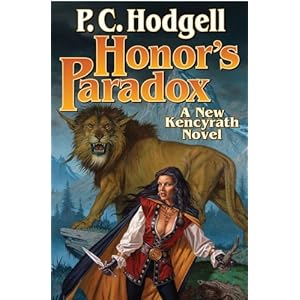
1. P.C. Hodgell, Honor's Paradox (Baen, 2011).
Hodgell's Kencyrath novels have an erratic publishing history. Honor's Paradox, the sixth, is the second new volume to be published under Baen's aegis, and despite the traditional hideous Baen fantasy cover, it's as brilliant a fantasy as ever.
Honor's Paradox takes up where Bound in Blood (2010) left off, and rounds out Jame's (Jamethiel Priest's-bane of Knorth) three-book stay at the war-training randon college. This is not a book that will make much sense without its predecessors, and if I had time I would make bouncy noises about them all. What it is, is marvellously inventive, wonderfully entertaining, and possessed of knotty problems of honour.
I recommend it exceedingly.
2. Pamela Dean, Tam Lin (Firebird, 2006).
This is a perfectly cromulent, entertaining and readable love letter to small liberal arts colleges of the 1970s after the US model, with extra balladic fairy tale. I acquired much enjoyment from the Shakespeare quotations, and from the Greek, but it stirred neither fire nor passion within me, nor any shock of recognition.
I'll put this one down to they do things differently over there. It's a perfectly nice book (I wouldn't care to hurt its feelings) but it has no resonance for me. I did not feel a great deal of emotional engagement. (Which is odd, because I generally like books about learning.) But there is no sense of drive or purpose to Janet-the-protagonist, not for me.
Other people's thoughts are solicited on this matter, because I'm having trouble articulating the disconnect between what I think I could have felt and what I actually did. (It feels like an American version of a boarding school story, but without the sports. Huh. Odd.)
This review has been brought to you by an abuse of the parenthesis.
nonfiction
3. Seneca, Six Tragedies, Oxford University Press, Oxford and New York, 2010. Translated with an introduction and notes by Emily Wilson.
This Oxford World's Classics edition collects six of the younger Seneca's nine extant tragedies: Phaedra, Oedipus, Medea, Trojan Women, Hercules Furens and Thyestes. There is some wonderful language in these plays, especially in Medea and in Hercules Furens, whose exchange between the usurping Lycus and Megara, wife of Hercules, is one of the best of its kind I've read anywhere. The translation is clear, lucid, and easily readable, and in this much it is enjoyable.
But Seneca, in his tragedies, tends towards the grotesque and the excessively macabre, describing mutilations and cannibalism and murder with - even by the standards of ancient tragedy - a rather disturbing relish. I'm not sure I like that. (Also, rampant misogyny, but ancient Greeks and Romans, what can you do?)
4. Marcus Aurelius, Meditations, Oxford University Press, Oxford and New York, 1998. Translated by A.S.L. Farquharson, with an introduction and notes by R.B. Rutherford.
Another Oxford World's Classics paperback. This translation was originally published in the 1940s, but this edition includes a selection of the correspondance of Fronto (trans. Rutherford, 1989), and it's this appendix that's the most interesting part of the book. Marcus Aurelius Antoninus Augustus, born Marcus Annius Verus, writes like an odd duck, and I can make very little sense of it.
It is philosophy, this I know. I suppose I should leave it at that.
I doubt 2012 shall equal 2011 in numbers of books. We shall see if it betters quantity by quality.
1. P.C. Hodgell, Honor's Paradox (Baen, 2011).
Hodgell's Kencyrath novels have an erratic publishing history. Honor's Paradox, the sixth, is the second new volume to be published under Baen's aegis, and despite the traditional hideous Baen fantasy cover, it's as brilliant a fantasy as ever.
Honor's Paradox takes up where Bound in Blood (2010) left off, and rounds out Jame's (Jamethiel Priest's-bane of Knorth) three-book stay at the war-training randon college. This is not a book that will make much sense without its predecessors, and if I had time I would make bouncy noises about them all. What it is, is marvellously inventive, wonderfully entertaining, and possessed of knotty problems of honour.
I recommend it exceedingly.
2. Pamela Dean, Tam Lin (Firebird, 2006).
This is a perfectly cromulent, entertaining and readable love letter to small liberal arts colleges of the 1970s after the US model, with extra balladic fairy tale. I acquired much enjoyment from the Shakespeare quotations, and from the Greek, but it stirred neither fire nor passion within me, nor any shock of recognition.
I'll put this one down to they do things differently over there. It's a perfectly nice book (I wouldn't care to hurt its feelings) but it has no resonance for me. I did not feel a great deal of emotional engagement. (Which is odd, because I generally like books about learning.) But there is no sense of drive or purpose to Janet-the-protagonist, not for me.
Other people's thoughts are solicited on this matter, because I'm having trouble articulating the disconnect between what I think I could have felt and what I actually did. (It feels like an American version of a boarding school story, but without the sports. Huh. Odd.)
This review has been brought to you by an abuse of the parenthesis.
nonfiction
3. Seneca, Six Tragedies, Oxford University Press, Oxford and New York, 2010. Translated with an introduction and notes by Emily Wilson.
This Oxford World's Classics edition collects six of the younger Seneca's nine extant tragedies: Phaedra, Oedipus, Medea, Trojan Women, Hercules Furens and Thyestes. There is some wonderful language in these plays, especially in Medea and in Hercules Furens, whose exchange between the usurping Lycus and Megara, wife of Hercules, is one of the best of its kind I've read anywhere. The translation is clear, lucid, and easily readable, and in this much it is enjoyable.
But Seneca, in his tragedies, tends towards the grotesque and the excessively macabre, describing mutilations and cannibalism and murder with - even by the standards of ancient tragedy - a rather disturbing relish. I'm not sure I like that. (Also, rampant misogyny, but ancient Greeks and Romans, what can you do?)
4. Marcus Aurelius, Meditations, Oxford University Press, Oxford and New York, 1998. Translated by A.S.L. Farquharson, with an introduction and notes by R.B. Rutherford.
Another Oxford World's Classics paperback. This translation was originally published in the 1940s, but this edition includes a selection of the correspondance of Fronto (trans. Rutherford, 1989), and it's this appendix that's the most interesting part of the book. Marcus Aurelius Antoninus Augustus, born Marcus Annius Verus, writes like an odd duck, and I can make very little sense of it.
It is philosophy, this I know. I suppose I should leave it at that.
I doubt 2012 shall equal 2011 in numbers of books. We shall see if it betters quantity by quality.

![[identity profile]](https://www.dreamwidth.org/img/silk/identity/openid.png)
no subject
Date: 2012-01-12 08:44 pm (UTC)no subject
Date: 2012-01-12 08:48 pm (UTC)no subject
Date: 2012-01-13 08:54 am (UTC)Talking of which, did you see Jim Hines' attempting to copy female character poses from book covers? (
no subject
Date: 2012-01-13 12:14 pm (UTC)Baen is, of course, (in)famous for their covers. Fortunately the book is brilliant.